The End of Coding in 2026 as We Know It? 😱 My Take on Infosys and Devin!
Hey everyone! 🚀
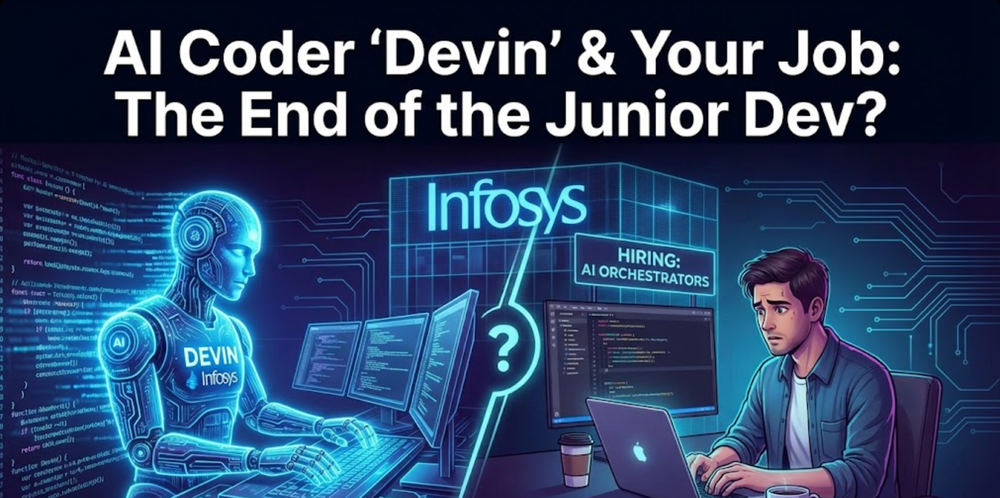
If you have been scrolling through tech news lately, you probably saw a name popping up everywhere: Devin. And no, I'm not talking about a new coworker in the cubicle next to you. I'm talking about the "world’s first fully autonomous AI software engineer" that Infosys just officially brought onto their team. 🗞️
A lot of people are asking: "Is this the end for freshers?" or "Will AI finally replace me?" I know it sounds like a sci-fi movie plot, but let's break down what’s actually happening without the panic. 🥳
What exactly is Devin?
Think of Devin as a supercharged version of the AI assistants we already use. While tools like ChatGPT or Copilot suggest code snippets, Devin can actually act like an engineer. It has its own browser, editor, and terminal.
If you give it a task like "Fix this bug in the repository" or "Migrate this old legacy code to the cloud," it doesn't just give you a text response. It goes in, plans the steps, writes the code, tests it, and fixes its own mistakes along the way. Cognition, the company behind Devin, built it to handle end-to-end tasks, not just help you finish a line of code.
Infosys is now integrating this into their Topaz Fabric, which is their massive AI-first ecosystem. 🚀
Is it taking away junior jobs?
This is the big question, right? 😱 The truth is a bit more "nuanced" than a simple yes or no.
Infosys is using Devin to automate what we call "brownfield engineering" which is a fancy way of saying they are using it for repetitive maintenance, fixing tech debt, and migrating ancient COBOL code that nobody wants to touch anyway.
For freshers and junior developers, the fear is real because these "repetitive" tasks are usually how beginners learn the ropes. If an AI can do 13% of the engineering work autonomously (which is what Devin’s benchmarks show), companies might need fewer people to do the basic "grunt work." 🗞️
However, Infosys still plans to hire thousands of graduates. The catch? They aren't looking for just "coders" anymore. They are looking for people who can orchestrate these AI agents. 🥳
The move from coder to orchestration
We are moving away from the era where being a "fast typer" made you a great developer. In 2026, the job is shifting toward Software Orchestration.
Instead of writing every single line of code yourself, your job will be to:
- Prompt and Guide: Defining the architecture and telling the AI what to build.
- Code Review: Since AI can still make "hallucination" mistakes, humans are the ultimate gatekeepers for security and quality.
- Complex Problem Solving: AI struggles with high-level system design and understanding deep business logic. That’s where you come in. 💻
Essentially, the "junior" role is being fast-forwarded. You are being asked to think like a mid-level engineer from day one. 🚀
What next right?
So, is the industry "dead"? Absolutely not. But the "basic coding" job market is definitely shrinking.
If you are a fresher or a student right now, the best thing you can do is stop fighting the AI and start leading it. Learn how to use agentic tools like Devin or OpenDevin. Focus on System Design, Security, and AI Governance.
The goal isn't to be better at coding than an AI (you won't win that race!), but to be better at building products than a person who doesn't use AI. 🥳
It's time to celebrate!
While change is scary, it also means we can build things faster than ever before. Imagine launching an entire MVP in a weekend because you had a "virtual engineer" helping you with the boring stuff!
Wait..
The tech world moves fast, and keeping up with these AI updates takes a lot of research. If you found this "simplified" breakdown helpful, share it with your college group or dev friends. 🚀
Are you excited about having an AI teammate, or are you still a bit skeptical? Let me know in the comments! 🥳
Subscribe to our newsletter Get the latest AI and tech simplifications delivered right to your inbox. 🗞️